
Choosing material for an access system affects far more than appearance. Stairs, ramps, walkways, platforms, and crossover systems may be exposed to rain, temperature changes, heavy foot traffic, industrial conditions, and years of repeated use. Why aluminum is the preferred material for access systems comes down to a combination of strength, low weight, corrosion resistance, durability, and design flexibility. For many commercial and industrial applications, aluminum delivers those benefits without creating the maintenance demands associated with wood or untreated steel.
REDD Team manufactures aluminum access systems in the United States at Hydro’s Delhi, Louisiana extrusion facility. Their product line includes ramps, stairs, walkways, platforms, generator access systems, crossover stairs, pedestrian bridges, and both standard and custom configurations.
How Can Aluminum Be Lightweight and Still Be Strong?
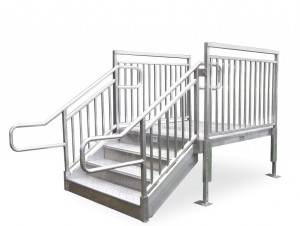
Weight and strength are often treated as opposites, but aluminum has an unusually high strength-to-weight ratio.
REDD Team reports that properly selected aluminum alloys can provide strength comparable to many structural steels while weighing roughly one-third as much. The company uses structural aluminum alloys in access products that need to support substantial loads without the bulk associated with heavier materials.
That difference becomes important long before anyone walks on the finished platform.
Lighter components can be easier to transport, position, and assemble at a jobsite. This is particularly useful when stairs or platforms need to reach rooftops, mechanical areas, modular buildings, or locations where getting a large welded structure into place would be difficult.
Less weight does not mean the system should be lightly engineered. REDD Team designs its access products around anticipated loads and states that its aluminum systems are engineered to support at least five times the anticipated load.
Why Is Corrosion Resistance So Important?
Access systems are often installed where moisture is unavoidable.
Exterior stairs deal with rain and snow. Marine platforms encounter humid, corrosive environments. Generator access equipment may spend its entire service life outdoors. Even indoor industrial facilities can expose equipment to water, chemicals, or changing humidity.
Aluminum naturally forms a thin protective oxide layer that helps resist corrosion. Unlike iron-containing materials, it does not develop the familiar red rust associated with steel.
That makes aluminum particularly useful where keeping a painted steel surface intact would otherwise become part of the maintenance schedule.
REDD Team also points to aluminum’s suitability for marine and other demanding environments where corrosion resistance matters.
How Does Aluminum Compare With Wood?
Wood can initially seem attractive because it is familiar and easy to work with. The long-term picture is different. Outdoor wood can absorb moisture, dry out, crack, splinter, warp, and eventually rot. Protective coatings may need to be reapplied as the material ages.
Aluminum does not have those same problems. It will not rot, splinter, or attract wood-damaging pests, and it retains its shape through changing weather conditions.
That can be especially important for a ramp or staircase.
A deck board that has begun to warp is inconvenient. A warped walking surface on an access route can interfere with stable footing or wheelchair travel.
For facilities departments responsible for several buildings, reducing this kind of recurring upkeep can be as valuable as the initial installation itself.
Does Aluminum Reduce Maintenance?
Generally, yes. Steel access equipment may require periodic attention to coatings, especially where scratches or weather exposure allow corrosion to begin. Wood typically has its own cycle of sealing, staining, painting, or replacing damaged pieces.
Aluminum does not require paint simply to protect it from rust.
REDD Team describes properly finished aluminum access products as low maintenance and notes that the material does not absorb water, rot, or crack the way some alternatives can.
Inspections are still important, of course.
Fasteners, railings, walking surfaces, anchors, and surrounding site conditions should be checked as appropriate. “Low maintenance” should never be interpreted as “never inspect it again.”
The difference is that routine maintenance does not have to revolve around preserving the base material.
Why Does Aluminum Work Well for Modular Systems?
Because it can be fabricated into precise components without making those components unnecessarily difficult to handle.
Aluminum can be extruded into complex shapes, allowing manufacturers to create structural pieces with consistent profiles. REDD Team uses 6000-series aluminum and incorporates extrusions into stairs, ramps, walkways, and other access products.
This manufacturing approach works particularly well with modular construction.
Instead of fabricating every access system as one large permanent structure, sections can be manufactured to work together and assembled according to the layout.
That creates options later.
A modular classroom may be relocated. Industrial equipment can be replaced. A generator bank might expand. A temporary facility may eventually move to another site.
REDD Team’s modular access products can often be disassembled, relocated, or reconfigured when requirements change.
That is difficult to do with concrete and often impractical with site-built wood.
Is Aluminum Useful for Both Indoor and Outdoor Access?
Yes, which is part of its appeal.
The same basic material can be used for wheelchair ramps outside a public building, OSHA stairs on a production floor, a walkway around generators, rooftop crossover stairs, or a platform in a marine environment.
REDD Team offers aluminum access products for commercial, industrial, municipal, institutional, military, and other applications.
Different environments still require different designs.
A wheelchair ramp has different slope and railing considerations from an industrial crossover. A generator platform may need room around service doors. A marine walkway may place additional emphasis on corrosion resistance and drainage.
Aluminum provides the material foundation. Engineering determines how it should be used.
What About Slip Resistance and Drainage?
Material alone does not create a safe walking surface. The design of the tread or decking matters too.
REDD Team incorporates slip-resistant and self-draining surfaces into many of its access systems. Open or perforated walking surfaces can allow rain, snowmelt, and debris to pass through rather than remaining across the path.
This can be particularly useful on exterior stairs, platforms, and industrial walkways where employees still need access during less-than-perfect weather.
Pairing aluminum construction with an appropriate walking surface gives the system both structural durability and practical day-to-day usability.
Final Thoughts
Ultimately, why aluminum is the preferred material for access systems is easy to understand once the entire life of the structure is considered. Aluminum combines a strong strength-to-weight ratio with corrosion resistance, weather durability, low maintenance, and the ability to be fabricated into modular components. It can serve applications ranging from public-access ramps to industrial stairs and generator platforms without the rot concerns of wood or the rust issues associated with untreated steel.
REDD Team manufactures American-made aluminum ramps, stairs, platforms, walkways, crossover systems, and other access products in standard and custom configurations. If your facility needs an access system designed around a building, piece of equipment, or unusual site condition, call REDD Team at (800) 648-3696 or request information online to discuss the application.