
REDD Team manufactures aluminum wheelchair ramp systems for schools in Boston, Massachusetts. Our assemblies are designed for fast installation at occupied K–12 campuses, modular classrooms, and higher-education facilities and for compliance with Massachusetts’ Architectural Access Board (AAB) regulations, 521 CMR, used citywide alongside the ADA Standards.
Massachusetts Wheelchair School Ramp Requirements
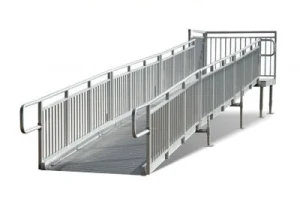
Massachusetts sets several school wheelchair ramp criteria that are more specific, and in some cases stricter, than the ADA.
Running Slope
The state limits the maximum running slope to 1:12 (8.33%) with no tolerance on slope. Individual runs may rise no more than 30 inches before a landing is required.
In existing conditions, a short run may use 1:10 (≤6″ rise) or 1:8 (≤3″ rise) when space is constrained.
Ramps
Massachusetts also sets a wider minimum for school ramps. They must provide 48 inches clear between handrails (not the ADA’s 36 inches).
Landings
Landings must be level, at least 60 inches long, and as wide as the ramp, with 60″ × 60″ landings where direction changes.
Outdoor ramps must be detailed so water does not accumulate on walking surfaces, and drop-offs must include edge protection.
Handrails
Unlike many jurisdictions, Massachusetts requires two handrail heights on ramps: a primary rail 34–38 inches above the ramp and a lower rail 18–20 inches, which is a helpful provision in elementary settings.
Rails must be continuous with 12-inch extensions at the top and bottom, graspable (1¼–2″ diameter), and maintain clearances.
For large school projects reviewed by the Boston Planning Department, accessibility conformance is documented during Article 80 review using 521 CMR as the reference standard.
Modular Aluminum Ramps for Boston Campuses
REDD Team’s Universal Wheelchair Ramp System is fabricated from structural aluminum and mechanically tested for long service life.
Components of the wheelchair ramp system are modular, reusable, and bolt-together, so installations can be scheduled for summer break, long weekends, or overnight work. They require no field welding.
Slip-resistant walking surfaces and continuous handrails support everyday safety for students, staff, and visitors in the wet, winter conditions that are typical of Boston.
Our layouts are prepared from threshold heights, grades, and required egress widths to comply with 521 CMR 24. Standardized landings and platforms make it straightforward to keep each run under 30 inches of rise, add intermediate landings where direction changes, and meet the Massachusetts’ state’s 48-inch clear width between rails.
Historic Schools, Modular Classrooms, & Swing Space
Boston’s school portfolio is quite diverse and includes historic buildings and periodic modular classroom clusters. Because our ramps are modular, you can reconfigure or relocate assemblies as programs shift.
Also, you can reuse components across phases when swing spaces move from one building to the next. Our approach supports capital projects while keeping accessible routes open during construction.
Winter Performance & Outdoor Detailing
521 CMR requires that outdoor ramps shed water easily. Our aluminum decking and drainage details help prevent ponding and ice formation to help ensure school safety.
For snow events, routine care is straightforward: clear runs and landings promptly and avoid corrosive de-icers that can leave residues at grade breaks.
Aluminum wheelchair ramp construction resists corrosion, reducing long-term maintenance compared with painted steel or treated wood, which is a huge advantage throughout Boston’s freeze–thaw cycles.
Integrate Stairs & Campus Circulation
Many campuses need both public ADA access and separate workforce or service access. Pair the Universal Wheelchair Ramp System with Universal Aluminum Stairs or OSHA stair lines to standardize circulation, finishes, and maintenance across buildings and portable classrooms.
REDD Team provides code-aligned submittals and layout assistance for projects throughout Boston, including BPS campuses and higher-ed facilities.
For Article 80 projects or complex renovations, our team coordinates documentation to demonstrate conformance with 521 CMR and ADA Standards.
Contact us onlineor at (800) 648-3696 for design assistance or to request a configuration for wheelchair ramps for schools in Boston, Massachusetts