
A generator may sit quietly for months, but when it needs inspection, fueling, maintenance, or repair, technicians need a safe way to reach it. That can become complicated when the unit is elevated, surrounded by conduit, positioned on uneven ground, or installed where a ladder simply is not a practical long-term solution. OSHA-compliant generator access stairs & platforms provide a permanent, organized route for employees who regularly need to work around this critical equipment.
REDD Team designs and manufactures aluminum generator access stairs, platforms, and walkways for commercial, industrial, and municipal facilities. Systems can be built for a single generator or configured to provide continuous access along several units.
Why Is Permanent Generator Access Important?
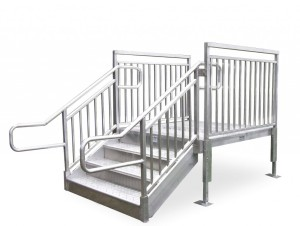
Generator maintenance is rarely performed empty-handed. A technician may be carrying tools, replacement parts, testing equipment, or supplies while trying to reach service doors and controls. Requiring that person to climb a portable ladder every time creates an unnecessary complication, particularly when access is frequent.
OSHA recognizes that distinction. Under its general-industry stairway standard, standard stairs are required when regular and routine travel is necessary between walking-working surfaces, including access to equipment operating platforms.
A properly designed stair and platform system gives workers a defined place to walk, stand, and work rather than forcing them to improvise access every time the generator needs attention.
What Makes Generator Stairs OSHA Compliant?
OSHA does not have one special set of dimensions labeled specifically for generator stairs. Instead, the access system must meet the applicable walking-working surface and stairway requirements.
For standard industrial stairs, OSHA generally requires:
- A stair angle between 30 and 50 degrees
- A maximum riser height of 9.5 inches
- A minimum tread depth of 9.5 inches
- At least 22 inches of clear stair width
- Uniform riser heights and tread depths
- Landings at least as wide as the stair and at least 30 inches deep
Stairs also have to support at least five times the normal anticipated live load and no less than a 1,000-pound concentrated load at any point.
Handrail, stair-rail, and fall-protection requirements depend on the configuration. For example, OSHA generally requires fall protection at unprotected walking-working surface edges 4 feet or more above a lower level. Stairway rail and handrail requirements also vary according to stair width and whether one or both sides are open.
This is why generator access should be designed around the actual site rather than pieced together from miscellaneous stairs and platforms.
Why Does Aluminum Make Sense Around Generators?
Generator access systems frequently live outdoors. Rain hits them. Humidity changes. Industrial environments can expose structures to chemicals or corrosive conditions. Some facilities also need access equipment that can be moved when the generator layout changes.
Aluminum handles those requirements well.
REDD Team uses aluminum for its generator platforms because it combines structural strength with relatively low weight and natural corrosion resistance. Unlike untreated steel, aluminum does not require paint simply to prevent rust. It also will not rot like wood.
The lighter weight helps during installation and later modifications. Modular components can be assembled without turning the site into a lengthy field-fabrication project.
That becomes particularly useful at facilities where downtime has to be kept to a minimum.
What Kind of Walking Surface Should a Generator Platform Have?
One that still provides reliable footing after it gets wet.
REDD Team uses slip-resistant Grip Strut-style decking on many generator access products. The perforated surface also allows water to drain rather than collecting across the platform. Less aggressive decking options can be specified when the application calls for something different.
That drainage is a practical detail.
Outdoor generators often sit in places exposed to weather, and maintenance cannot always wait for a perfectly dry afternoon. A platform that sheds water gives workers a more predictable walking and working surface.
REDD Team also uses high-visibility yellow powder-coated handrails as a standard option on its generator platforms and walkways, helping define the access route around equipment.
What if the Generator Is Surrounded by Pipes or Other Equipment?
This is where modular and custom design becomes especially valuable.
Generator installations are rarely identical. One facility may have a clear approach from the front. Another may have conduit, piping, curbs, walls, or adjacent equipment limiting where stairs can be placed.
REDD Team manufactures several types of industrial access products that can solve those kinds of problems, including straight stairs, crossover stairs, cantilevered platforms, rolling systems, and adjustable-height configurations.
Adjustable telescopic legs can also help level a platform when site conditions are less than ideal. REDD Team can customize stair angle, landing dimensions, tread rise and run, and other details around the application.
The objective is not to force the generator to fit a stock staircase.
It is to create access that fits the generator.
Can One Platform Serve Multiple Generators?
Yes, and that can make maintenance much easier.
Facilities with generator banks do not necessarily need a separate stairway for every unit. REDD Team can design a continuous platform that runs alongside two or more generators, allowing technicians to move between service points without repeatedly descending one set of stairs and climbing another.
That can create a cleaner work area while reducing unnecessary movement.
It may also make more efficient use of limited space, especially where several generators sit together in a dedicated utility area.
The platform can be designed around service-door locations so employees can reach the parts of each generator they actually need to inspect.
What About Generator Enclosures?
An enclosure can make access planning more complicated.
Doors need room to open. Technicians need enough standing space to perform their work. Pipes and electrical conduit may pass alongside the equipment, and elevated thresholds or foundations can create awkward changes in height.
REDD Team specifically manufactures stair and walkway systems for generator enclosures so facilities can establish defined access routes around these obstacles. Permanent stairs and platforms can reduce the need for workers to step over piping, balance on uneven surfaces, or rely on temporary equipment while performing routine maintenance.
That is one of those improvements that may seem simple once it is installed.
Beforehand, everyone was simply working around the problem.
Are Modular Aluminum Systems Permanent?
They can be permanent without being impossible to change.
REDD Team’s generator access systems can be anchored for long-term use while retaining the advantages of modular construction. If equipment is replaced or the facility layout changes later, sections may be dismantled and reconfigured rather than discarded entirely. That flexibility has real value in industrial facilities.
Generators get upgraded. Production areas change. Buildings are expanded.
Access equipment does not necessarily have to become obsolete every time the site does.
Choose OSHA-Compliant Generator Access Stairs & Platforms Designed for the Site
The best OSHA-compliant generator access stairs & platforms do more than get a technician from ground level to a maintenance door. They create a dependable walking-working surface with appropriate stair geometry, railings, slip resistance, drainage, and enough room to perform the work safely. The exact configuration should be based on generator height, service points, surrounding equipment, site conditions, and the OSHA requirements that apply to the facility.
REDD Team manufactures standard and custom aluminum generator access stairs, platforms, walkways, crossover stairs, and related industrial access systems in the United States. Whether your facility has one elevated generator or several units that need to be connected by a continuous work platform, call REDD Team at (800) 648-3696 or request a quote to discuss an access system engineered around your equipment and site.