
Large standby and industrial generators are rarely positioned with convenient everyday access in mind. They may sit on elevated concrete pads, behind buildings, inside mechanical yards, or above flood elevations. That placement can protect the equipment, but it can also leave technicians climbing temporary steps or trying to work from uneven ground. OSHA-compliant generator access platforms create a permanent route to service points and give maintenance personnel a stable place to stand while inspecting, testing, or repairing the equipment.
REDD Team designs and manufactures aluminum generator access platforms, stairs, and walkways for commercial, industrial, and municipal facilities. Systems can be configured for one generator or extended to accommodate multiple units while fitting the actual equipment layout.
Why Do Generators Need Permanent Access Platforms?
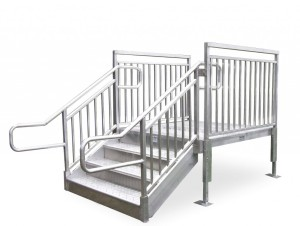
Generators require regular attention even when they are not running.
Technicians may need to check filters, fluids, batteries, controls, connections, fuel systems, or other components. Routine testing and scheduled maintenance can also require access to several points around the unit.
If those areas are elevated, a portable ladder may technically get someone there, but it does not necessarily provide a practical working area once the technician arrives.
OSHA’s general-industry stairway requirements specifically call for standard stairs when regular and routine travel is necessary between walking-working surfaces, including access to equipment operating platforms.
A permanent stair-and-platform system turns repeated maintenance access into a defined part of the facility rather than something workers have to improvise each time.
What Makes a Generator Access Platform OSHA Compliant?
There is no single OSHA specification written only for generator platforms. Instead, the system needs to meet the applicable requirements for stairs, walking-working surfaces, railings, and fall protection.
For standard industrial stairs, OSHA requires an angle between 30 and 50 degrees, a maximum riser height of 9.5 inches, a minimum tread depth of 9.5 inches, and at least 22 inches of clear width between vertical barriers. Stair landings must generally be at least as wide as the stair and at least 30 inches deep in the direction of travel.
Guardrail requirements also become important around elevated platforms. OSHA generally requires top rails to be 42 inches, plus or minus 3 inches, above the walking-working surface, along with appropriate intermediate protection.
The exact configuration depends on the site, which is why measurements and intended use matter before fabrication begins.
Why Is Working Space Around the Generator Important?
Reaching the generator is only half the problem. A technician still needs enough room to work.
Generator housings often have large service doors that swing outward. Filters, electrical panels, controls, battery compartments, and other components may be positioned at several locations along the enclosure.
A platform that places a railing directly in front of a service door may technically provide access while making maintenance harder.
REDD Team can design platforms around the service areas technicians actually need to reach. Custom dimensions allow the platform, stairs, and railings to work around enclosure doors, piping, conduit, and other nearby infrastructure.
Good access should disappear into the maintenance routine. Nobody should have to work around the platform itself.
What Makes Aluminum a Good Choice Around Generators?
Outdoor equipment calls for a material that can live outdoors too.
Aluminum is naturally corrosion resistant and does not require paint simply to prevent rust. It is also much lighter than comparable steel structures, which can simplify transportation and installation around mechanical yards or elevated equipment.
REDD Team’s generator access products use structural aluminum and are designed for long-term, low-maintenance service.
Lower weight can also be useful when an existing facility is being upgraded. Instead of bringing a large welded structure into a crowded equipment area, modular components can be positioned and assembled around what is already there.
For facilities where generators may eventually be replaced or rearranged, that flexibility has another advantage: modular access systems can be easier to modify than permanently fabricated alternatives.
How Do Slip-Resistant Platforms Help Outdoors?
Generator maintenance does not always happen on a dry day. Rainwater, mud, snow, or other moisture can make exterior walking surfaces more difficult to use. That is particularly important on elevated stairs and platforms where dependable footing matters.
REDD Team uses Grip Strut-style material on its generator access platforms to create a highly slip-resistant walking surface. The perforated design also allows water to drain through instead of collecting on top. Less aggressive decking can be supplied when a particular application calls for another surface.
It is a fairly simple design decision, but an important one.
Standing water should not become another obstacle between a technician and equipment that needs immediate attention.
Can One Platform Provide Access to Several Generators?
Yes. Facilities with multiple generators do not necessarily need an independent staircase and small landing for every unit.
REDD Team can design continuous platform and walkway configurations that provide access along a bank of generators.
This allows technicians to climb once and move between service locations without repeatedly returning to ground level.
A connected configuration can also help organize pedestrian movement around a busy mechanical yard. Instead of workers choosing different paths between equipment, the platform establishes where normal service access should occur.
The layout still needs to preserve clearance around each unit, including ventilation and service doors.
What if the Generator Is Elevated for Flood Protection?
This is a common reason purpose-built access becomes necessary.
Critical equipment may be placed on an elevated pad to reduce exposure to flooding. Once the generator goes up, however, the service route has to reach the same elevation.
REDD Team specifically identifies elevated generators and equipment located in difficult mechanical-yard positions as applications for engineered aluminum access systems.
The resulting system can combine stairs, landings, platforms, and railings according to the required height.
That provides considerably better long-term access than treating the elevation difference as a problem for maintenance personnel to solve after installation.
Build the Access System Around the Generator
The best OSHA-compliant generator access platforms are designed around how the equipment will actually be maintained. Height is important, but so are service-door locations, required working space, surrounding pipes and conduit, stair placement, drainage, walking surfaces, railings, and the frequency with which employees use the route.
REDD Team manufactures aluminum generator platforms, stairs, walkways, crossover systems, and other commercial and industrial access products in the United States. Standard and custom configurations are available for single generators, multiple-unit installations, elevated equipment, and challenging facility layouts.
If your generator is difficult to inspect or maintain without a ladder or improvised access, contact REDD Team at (800) 648-3696 or request a quote online. The team can develop an aluminum access system around the generator, the facility, and the OSHA requirements that apply to the project.