
When care moves fast at vaccination sites, temporary clinics, and mobile labs it is imperative that you have OSHA & ADA-compliant wheelchair ramps for portable medical buildings. Patients, clinicians, and deliveries all share the same path. The route has to be safe in all weather, easy to navigate, and quick to deploy without disrupting the facilities care schedule. At REDD Team, we design modular aluminum ramp systems that meet ADA standards, align with OSHA jobsite safety expectations, and install cleanly on tight timelines.
Built for Healthcare Pace, Safety, and Cleanability
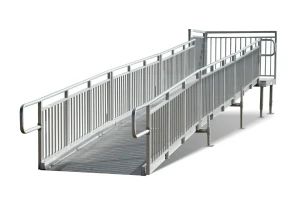
Portable medical buildings live in high-stress environments such as parking lots, fairgrounds, and hospital overflow zones. They are places that change week to week. Aluminum shines here because it won’t rust or splinter, and it handles frequent wipe-downs and pressure washing without degrading coatings.
Open-profile, non-slip decking sheds rain and snow to keep traction, and it’s easy to sanitize.
Continuous handrails and guardrails provide a secure, predictable feel for patients using walkers or wheelchairs. In addition, toe boards help prevent dropped items from rolling off the edge.
When it comes to wheelchair ramps, compliance starts with geometry. Our slopes balance comfort. Add level landings at predictable intervals and align platforms with door swings so no one is fighting a threshold on a slope. In addition, clear widths allow two-way flow when traffic peaks.
For OSHA considerations, we integrate edge protection where needed. Also, we provide tread patterns with reliable grip, and anchoring details that suit varied surfaces from asphalt to compacted gravel. All without improvisation in the field.
Modular design keeps things flexible. If the clinic expands, a second entrance opens, or the entry shifts for a drive-through lane, all of the sections reconfigure quickly using only standard tools. There are no hot work permits required, no welding, and no long cure times. You can quickly move the wheelchair ramps.
Plan the Patient Journey, Not Just the Drawing
Healthcare is about keeping things flowing throughout the facility.
Start outside:
- Where do vehicles queue?
- Where will EMS stage?
- How do pedestrians cross drive aisles?
Place landings as decision points that connect to clear signage, so patients can pause without blocking the path. Keep sightlines open for staff to monitor movement from check-in and so they know exactly what is going on with ease.
Add task lighting along rails or platform edges for early-morning and evening operations. They should be bright enough to guide but soft enough to avoid glare.
Inside the door, small elevation changes matter so scales, specimen pass-throughs and staging carts by triage can flow. Compact platforms can smooth those transitions so the entire route, curb to counter, feels consistent. If you anticipate gurney or cart traffic, specify generous turning space on landings and durable fasteners that shrug off real-world bumps.
Fast Deployment, Easy Ownership, Clean Exit
Pop-up medical sites can’t afford downtime. Prefabricated aluminum ramps arrive ready to assemble, level, and anchor with standard tools. Assembly can often be carried out in a single shift. When the clinic moves or things change, you unbolt, relocate, and get back to serving patients, with the same system and components.
In short, OSHA & ADA-compliant wheelchair ramps for portable medical buildings help you deliver safe, dignified access at the speed healthcare demands. With REDD Team, you get durable materials, clean detailing, and the flexibility to adapt as patient volumes and site conditions change. Call us at (800) 648-3696 or contact us online. Standing up a portable clinic fast? Send REDD Team your trailer elevations, site photos, and target go-live date. We’ll return a clinic-ready ramp layout, anchoring plan, and a rapid budget quote so you can order with confidence.