
Data centers are designed around continuous operation. Rows of servers may get most of the attention, but the infrastructure behind them is just as important. Backup generators, cooling equipment, electrical systems, rooftop mechanical units, piping, and other support equipment all need to be inspected and maintained. Data center access solutions give technicians a defined way to reach those areas without relying on portable ladders or awkward routes around equipment.
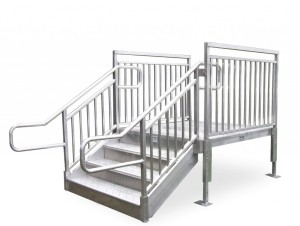
REDD Team manufactures aluminum stairs, platforms, walkways, crossover stairs, and generator access systems that can be configured for demanding commercial and industrial facilities. Standard systems are available, while custom designs can address unusual elevations, tight spaces, equipment layouts, and changing site requirements.
Where Are Access Systems Needed in a Data Center?
A data center is more than the building that holds the server racks.
Behind the scenes, the property may include large generators, cooling systems, electrical equipment, mechanical yards, rooftop infrastructure, fuel-related equipment, piping, and utility runs. Many of these components are elevated or positioned where direct access is difficult.
That can create situations where employees need to climb over a pipe, work from a ladder, or navigate around equipment just to reach a routine service point.
Permanent access equipment can provide a better option.
Depending on the facility, that might mean stairs leading to an elevated generator, a platform in front of service doors, a walkway alongside a bank of equipment, or crossover stairs carrying workers above pipes and conduit.
The goal is straightforward: make the route to the equipment as deliberate as the equipment installation itself.
Why Are Generator Access Platforms Important?
Backup power is fundamental to data center resilience.
Generators therefore require routine inspections, testing, maintenance, and repairs. Yet large commercial generators are often elevated, enclosed, or surrounded by infrastructure that makes their service areas difficult to reach from ground level.
REDD Team manufactures modular aluminum generator access systems that can include stairs, platforms, walkways, and railings. Platforms can be arranged alongside individual units or extended to serve multiple generators.
That provides technicians with a stable place to stand while opening service doors and working on equipment.
It also reduces the need to repeatedly reposition portable ladders around a generator yard.
A good layout should consider exactly where maintenance occurs. Doors still need room to open, controls must remain accessible, and the platform should not interfere with ventilation, conduit, piping, or other generator components.
How Can Crossover Stairs Solve Data Center Access Problems?
Data centers tend to contain a lot of infrastructure that cannot simply be moved out of the way.
Pipes, cable runs, ductwork, curbs, and mechanical systems can interrupt a normal walking route. Asking employees to step over those obstructions is not a good long-term access plan.
Crossover stairs create a designated path above them.
REDD Team’s aluminum product line includes OSHA crossover stairs designed for industrial applications where equipment or utilities obstruct a walkway. The height and platform configuration can be selected around the obstacle and available space.
This can be particularly useful on rooftops and in mechanical areas.
Instead of technicians developing their own shortcuts each time they service equipment, the facility establishes one consistent route.
When Does OSHA Require Permanent Stairs?
Frequency of access matters. OSHA’s general-industry standards require standard stairs when employees routinely travel between walking-working surfaces, including situations involving access to operating platforms around equipment.
Standard stairs must meet requirements governing dimensions, slope, uniformity, strength, and landings. Applicable railing and fall-protection requirements also have to be considered based on the configuration and elevation.
That distinction is important in a data center.
A ladder may make sense for a location accessed very rarely. It becomes much less practical when technicians need to reach the same equipment repeatedly for inspection and maintenance.
REDD Team offers OSHA-oriented industrial stair and crossover configurations in addition to general-code and accessibility products, allowing the access system to be matched to its actual use.
Why Is Aluminum Useful for Data Center Access?
The first advantage is weight. REDD Team notes that aluminum weighs approximately one-third as much as steel, which can make transportation and installation considerably easier. Its ramps and stairs can arrive pre-built or pre-engineered for efficient field installation.
That can matter when access equipment must be moved through an existing facility or placed on a roof where handling large steel assemblies would be difficult.
Aluminum also has natural corrosion resistance. Outdoor generator yards, cooling equipment areas, and rooftop installations regularly encounter rain and humidity. Aluminum does not need protective paint simply to prevent the rust associated with untreated steel.
There is also less ongoing material maintenance compared with wood, which can absorb moisture, warp, or deteriorate over time.
For a facility where maintenance resources are better spent on mission-critical equipment, that is a practical advantage.
What About Walking Surfaces Around Outdoor Equipment?
A platform should not become difficult to use every time it rains.
REDD Team’s generator access platforms use perforated walking surfaces designed to let water drain instead of pooling on top. The company also provides slip-resistant decking for access equipment used in demanding environments.
That becomes particularly useful in exterior mechanical yards and rooftop areas.
Drainage is a small design detail until someone needs to reach a generator immediately after a storm. Then it matters quite a bit.
Can Access Equipment Be Customized Around Existing Infrastructure?
Often, it has to be. Few data centers have perfectly empty spaces waiting for a stock staircase.
A proposed access route may need to avoid electrical equipment, preserve service clearances, clear existing pipes, reach a specific door, or fit between pieces of mechanical equipment.
REDD Team provides engineering and design support for both standard and custom access solutions. Elevations, load requirements, and unusual site conditions can be incorporated into the design.
Modular construction creates another advantage.
If the facility expands or equipment is replaced, an aluminum system may be easier to modify, relocate, or reconfigure than a site-built concrete or welded structure.
That flexibility fits an industry where infrastructure rarely remains unchanged forever.
Plan Access Before It Becomes a Maintenance Problem
It is easy to concentrate on the equipment first and assume technicians will figure out how to reach it later.
That approach tends to produce ladders leaning against generators, improvised paths around pipework, and service areas that are technically reachable but unnecessarily difficult to use.
Planning access at the same time as the equipment gives facilities teams the opportunity to consider stair placement, working space, walking routes, railings, clearance, and future maintenance before the area becomes crowded.
Choose Data Center Access Solutions Built Around the Facility
Effective data center access solutions should make routine work simpler without getting in the way of the infrastructure technicians are there to maintain. Aluminum stairs can provide permanent access to elevated equipment, platforms can create stable service areas, walkways can connect maintenance points, and crossover systems can provide a defined route over utilities and other obstructions.
REDD Team manufactures aluminum access products in the United States and provides engineering and design support for standard and custom applications. Its product range includes OSHA stairs, crossover stairs, walkways, platforms, and generator access systems for commercial and industrial facilities nationwide.
For help planning access around generators, cooling equipment, mechanical systems, or other data center infrastructure, contact REDD Team at (800) 648-3696 or request a quote online. The right access system can make equipment considerably easier to service today while leaving room for the facility to change tomorrow.