
In busy plants and rooftops, the straight-line path is rarely clear or straightforward. It’s often blocked by pipes, conveyors, cable trays, dikes, curbs, and parapets. The obstacles interrupt travel and force risky workarounds. Crossover stair systems solve that problem by creating a safe, elevated walkway over the obstruction, with stairs on each side and a guarded platform on top, so people can safely move where they need to without stepping into process areas, traffic lanes, or energized zones. In this blog post, we’ll explore crossover stair systems: what they are and when to use them.
What Defines a Crossover Stair
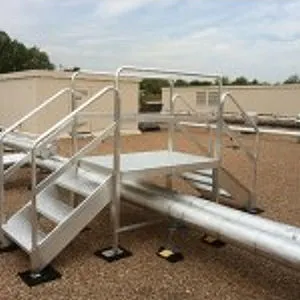 A true crossover isn’t just “a couple of steps and a plank.” It’s more complicated. Basically, it’s a purpose-built assembly that includes the following criteria:
- Two fixed stairways set at a safe angle (standard industrial stairs install 30°–50° from horizontal).
- A platform at least as wide as the stair and ≥30 inches deep in the direction of travel, sized for turning and task work.
- Continuous rails and guardrails on open sides, with toe boards where tools or parts could drop.
- Slip-resistant walking surfaces and transitions that manage water, debris, and tracked-in moisture.
Those elements line up with OSHA’s Walking-Working Surfaces standard.
When to Use a Crossover
Use a crossover stair system when you need to separate people from potential hazards and maintain flow without altering process equipment:
- Over conveyors and production lines to keep pedestrians out of the product flow.
- Across pipe or cable runs so technicians reach valves, filters, or panels without stepping on utilities.
- Rooftops to navigate parapets, duct chases, and low curbs while keeping to a guarded route.
- Around vehicle aisles in warehouses to reduce forklift/pedestrian conflicts and pinch points.
- Across containment berms or dikes at tank farms and utility yards.
Well-placed crossovers do more than check a safety box—they shorten routes, reduce congestion, and give maintenance a predictable, protected path.
Why Aluminum Crossovers
Aluminum brings high strength without rust or repaint cycles, which matters on wet roofs, washdown lines, and coastal or humid sites.
REDD Team fabricates crossover stairs from 6000-series aluminum, including 6061-T6. It’s very tough, weldable, and much lighter to handle than steel. The lighter weight reduces rigging, speeds installs, and makes later repositioning feasible without hot work.
Modular Systems That Move With Your Facility
Crossover needs change as lines shift and equipment moves. REDD Team designs modular, bolt-together aluminum systems that feature stairs, platforms, posts, and rails that assemble with repeatable hardware, install during short outages, and can be reconfigured or relocated when the layout evolves. In addition, rooftop variants handle parapets and low mechanical curbs; plant-floor variants span conveyors, pipe racks, and trench runs.
What You Get From REDD Team
REDD Team supplies OSHA-aligned crossover stairs and platforms in aluminum. They’re engineered for industrial loads and detailed with slip-resistant, self-draining surfaces.
Our systems arrive as modular kits for fast, clean installation with matched rails, posts, and connections, and can be tailored to conveyor widths, pipe diameters, rooftop curbs, and required clearances. We can help you select the right stair angle, platform size, and guard configuration for your process and your site.
Considering a crossover stair system in your facility? We’ll propose a crossover stair layout that meets OSHA expectations for stair geometry, guardrails, and walking surfaces, and keeps your people safely moving above the hazards. Contact REDD Team to learn more today at (800) 648-3696 or contact us online.