
When you design or upgrade a commercial building, accessibility isn’t optional, it’s a requirement. Building code requirements for ramps in commercial facilities are set out by the Americans with Disabilities Act (ADA) Standards and the International Building Code (IBC), along with state or local amendments. Meeting these standards ensures that entrances are usable for everyone to use safely, inspections pass smoothly, and liability risks are minimized.
The Core Geometry
At the heart of ramp design are slope and rise.
The codes are black and white:
- Running slope: Maximum 1:12 (8.33%)
- Cross slope: Maximum 1:48
- Rise per run: No more than 30 inches before a landing is required
These limits are needed to ensure safety. They prevent ramps from becoming too steep, which can make them unsafe or unusable for wheelchairs, strollers, or carts.
Landings and Clearances
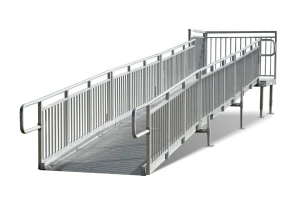
Level landings are critical for safety and to ensure that they are easy to traverse.
Under ADA and IBC:
- Landings must be provided at the top, bottom, and at turns.
- Landings must be at least 60 inches long and as wide as the ramp.
- Turning landings should provide at least 60 by 60 inches of clear space for maneuvering.
These landing requirements keep ramps safe and comfortable for users who may need to stop, rest, or turn while navigating across the surface.
Width Requirements
Commercial facilities serve many different users.
Codes require the following:
- Minimum clear width of 36 inches between handrails (ADA)
- Wider ramps are often recommended in high-traffic buildings like offices, hospitals, and shopping centers to accommodate two-way travel.
Handrails and Edge Protection
Safety features are just as important as slope and width.
- Handrails: Handrails are required on both sides of ramps with a rise greater than 6 inches. They must be continuous and graspable. The ramps have to be installed 34–38 inches high, with extensions at the top and bottom.
- Edge protection: Edge protection is required at runs and landings to prevent wheels or feet from leaving the ramp surface.
Surface and Maintenance Requirements
Building codes also cover performance in real-world conditions such as the following:
- Surfaces must be stable, firm, and slip-resistant.
- Ramps must be designed to avoid water accumulation.
- Materials like aluminum with slip-resistant decking help keep ramps safe in wet or icy conditions.
Integration with Commercial Spaces
For commercial facilities, ramps aren’t just about compliance. In fact, they’re about functionality and appearance.
Ramps must connect smoothly with doorways, plazas, and interior circulation without obstructing traffic. Threshold plates, proper drainage, and coordinated stairs or platforms ensure that the accessible route feels intentional, not added as an afterthought.
Why REDD Team Ramps Work for Commercial Facilities
REDD Team manufactures prefabricated aluminum ramp systems that are designed with these building code requirements built in.
Our ramps are:
- Prefabricated: Bolt-together kits for fast installation with minimal disruption.
- Compliant: Designed to ADA, IBC, and ICC A117.1 standards.
- Durable: Slip-resistant, corrosion-resistant aluminum that reduces long-term maintenance.
- Adaptable: Modular components that can be relocated or reconfigured as entrances change.
With REDD Team, you don’t just get a ramp, you get a complete accessibility solution that looks professional, passes inspection, and keeps the public safe.
When planning upgrades, keep in mind that building code requirements for ramps in commercial facilities are there to protect both users and building owners. Call REDD Team at (800) 648-3696 or contact us online to request a site-specific layout and quote. We’ll design a prefabricated aluminum ramp system that meets every code requirement and performs for years to come.