
Government buildings have to work for a wide range of people every day. City halls, courthouses, libraries, public safety buildings, administrative offices, and other civic facilities may serve employees, visitors, delivery personnel, voters, and people using wheelchairs or other mobility devices, often all within the same entrance. Aluminum access systems for government facilities can provide a durable way to improve those routes with ramps, stairs, walkways, platforms, and other components designed around the building and its users.
REDD Team manufactures aluminum access products in the United States for municipal, government, military, commercial, and institutional applications. Its systems can be configured for both permanent and changing site conditions, which can be especially useful for public facilities that are renovated, expanded, or temporarily reconfigured over time.
Why Do Government Facilities Need More Than a Basic Ramp?
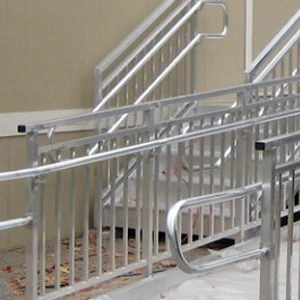
Accessibility is rarely solved by placing a ramp beside the front steps and calling the project finished.
A person still needs to reach the ramp from the accessible route, move through any turns or landings, approach the entrance, and maneuver through the doorway. The site may also need stairs for general pedestrian traffic, walkways connecting modular buildings, or platforms at elevated entrances.
That is why the entire route should be considered together.
REDD Team manufactures a coordinated family of access products that includes its universal wheelchair ramp system, universal stair systems, universal walkways, viewing platforms, pedestrian bridges, and other configurations. For government buildings, combining these components can create an entrance that looks intentional rather than pieced together over several unrelated projects.
What Accessibility Requirements Apply to Public Buildings?
For state and local government facilities, accessibility obligations can fall under Title II of the Americans with Disabilities Act, along with applicable building codes and local requirements.
The physical design of a ramp can involve requirements for slope, width, landings, handrails, edge protection, and walking surfaces. The accessible route leading to and from that ramp also matters.
REDD Team’s universal wheelchair ramp system is designed for ADA-oriented applications and can be configured around different entrances and site conditions. The company also manufactures stairs and other products for general-code and OSHA applications where employee or service access is needed. (REDD Team)
The important distinction is that not every access product serves the same purpose.
A public entrance ramp and a maintenance stairway may be located at the same facility, but they are designed around different users and regulatory requirements.
Why Is Aluminum Well Suited to Government Properties?
Public facilities need products that can tolerate years of use without creating an unnecessary maintenance burden.
Aluminum works particularly well in that environment because it is naturally corrosion resistant, lightweight, noncombustible, and durable. REDD Team uses 6000-series aluminum alloys in its access systems, including 6061-T6 for primary structural components in some product lines.
Unlike wood, aluminum does not rot, splinter, or warp as it repeatedly gets wet and dries.
It also avoids the rust concerns associated with unprotected steel.
That can make a difference at city halls, libraries, police and fire facilities, or other public properties where stairs and ramps remain outdoors in rain, snow, humidity, and changing temperatures year after year.
Facilities departments already have enough on their maintenance lists.
An access system should not add more work than necessary.
Can Modular Systems Be Used During Renovations?
Yes, and this is one of aluminum’s strongest advantages.
Government facilities change. An entrance may close during construction. A temporary office could be added during a renovation. Security screening may move. A modular building might be placed on the property for several years and then relocated.
A concrete access structure is difficult to adapt once those conditions change.
REDD Team’s modular aluminum systems can be disassembled, relocated, and reconfigured for different layouts. Its walkway system, for example, is specifically designed so components can be moved and assembled into new configurations rather than being treated as a one-time installation.
For a public agency managing several properties, that reusability can provide considerable long-term value.
What About High-Traffic Entrances?
Government buildings may experience routine daily use followed by sudden periods of heavy traffic.
A courthouse can become busy first thing in the morning. A city hall may see larger crowds during meetings. Libraries and public service offices experience steady pedestrian activity throughout the day. Election periods can put additional pressure on certain civic facilities.
Access systems need to be ready for all of it.
REDD Team emphasizes aluminum for government and civic buildings because the material withstands weather and repeated use while offering slip-resistant, self-draining walking surfaces. These characteristics can be particularly useful at exterior entrances exposed to rain, snow, or deicing materials.
Continuous handrails and appropriate edge protection can also be integrated into accessible ramp configurations.
The result should feel stable and predictable whether someone uses the entrance once a year or walks through it every morning.
Where Can Aluminum Walkways and Platforms Be Useful?
Not every government access problem occurs at the front door.
Municipal properties may include modular offices, temporary administrative buildings, utility areas, public works facilities, equipment platforms, and separate structures that need to be connected.
REDD Team’s aluminum walkways are designed for municipalities, schools, modular buildings, and similar applications. They use slip-resistant decking and modular components that can be adjusted and reused.
Platforms can solve another type of problem.
A government facility may need an elevated area for equipment access, a public viewing location, or a transition between different elevations. REDD Team offers both standard and custom platform systems that can account for elevation, load, and site-specific requirements.
That ability to combine products allows a facility to address more than one access challenge with the same material and design approach.
Should Stairs and Ramps Be Planned Together?
Whenever possible, yes. If stairs are installed first, the accessible ramp sometimes gets pushed into whatever space remains. That can create unnecessary turns, awkward landings, or an entrance layout that feels like an afterthought.
REDD Team recommends treating ramps and stairs as a coordinated access system. Planning both together allows the approach, landings, railings, and pedestrian flow to be considered from the beginning.
Government facilities often serve people with very different mobility needs.
The most effective entrance gives everyone an appropriate route without making one group feel as though they were accommodated later.
Choose Aluminum Access Systems for Government Facilities That Can Adapt
The best aluminum access systems for government facilities combine accessibility, durability, flexibility, and thoughtful site planning. A municipal building may need an ADA-oriented ramp at its public entrance, stairs for general circulation, a walkway connecting temporary structures, or a platform for an elevated service area. Aluminum allows those systems to remain durable while offering the flexibility to change when the facility does.
REDD Team manufactures American-made aluminum ramps, stairs, walkways, platforms, crossover systems, and pedestrian bridges for government, municipal, military, and other public-sector applications. Its modular systems can be configured for both permanent installations and facilities where future relocation or reconfiguration is likely.
For help planning an access system for a city hall, courthouse, library, public safety facility, municipal office, or other government property, contact REDD Team at (800) 648-3696 or request a quote online.