
Power generation facilities are built around equipment, not pedestrian convenience. Generators, turbines, control systems, piping, electrical runs, cooling equipment, and elevated service points can leave maintenance teams working around some awkward obstacles. Access solutions for power generation facilities create defined ways to reach that equipment without depending on portable ladders, makeshift steps, or routes that require employees to climb over pipes and other infrastructure.
REDD Team designs and manufactures aluminum stairs, platforms, walkways, crossover stairs, and generator access systems for industrial and commercial applications. Because configurations can be customized, these systems can be planned around the equipment instead of forcing a facility to rearrange its operations around a stock set of stairs.
Why Is Equipment Access Such an Important Part of Power Generation?
Most power equipment requires regular attention. Generators need inspections, testing, filter and fluid service, battery maintenance, repairs, and occasional component replacements. Other equipment throughout a power facility may require technicians to reach valves, controls, motors, electrical cabinets, or monitoring points.
The access route matters because technicians rarely arrive empty-handed.
Someone may be carrying tools, testing equipment, parts, or supplies while moving between levels. Requiring that worker to balance those items while climbing an improvised ladder can make an ordinary service call unnecessarily difficult.
OSHA’s general-industry stair standard specifically requires standard stairs where operations involve regular and routine travel between walking-working surfaces, including access to equipment operating platforms.
Permanent access turns equipment maintenance into a more predictable task.
What Types of Access Systems Can a Power Facility Use?
There is rarely one product that solves every problem across an entire site.
A generator mounted on an elevated concrete pad may need a stair and work platform. A technician trying to reach equipment behind a pipe bank might need a crossover stair. A long row of equipment could benefit from a continuous walkway that keeps workers on a defined route.
Common options include:
- Aluminum access stairs
- Elevated work platforms
- Generator service platforms
- Walkways between equipment
- OSHA crossover stairs
- Stair-and-platform combinations
- Custom access configurations
REDD Team’s aluminum product line includes each of these types of systems, and the company offers both standard and custom designs for unusual access requirements.
The better question is not, “Which staircase should we buy?”
It is, “Where do employees actually need to go?”
How Do Generator Access Platforms Improve Maintenance?
Generators often present a very specific access problem because their service doors and components may sit several feet above the surrounding surface.
REDD Team designs generator access platforms around the areas technicians need to reach. A platform can provide enough room to stand outside maintenance doors instead of forcing workers to perform service while standing on a ladder or narrow step. Systems can also serve multiple generators when equipment is grouped together.
Layout deserves careful thought.
Cooling systems, battery boxes, filters, engine components, vents, louvers, and access doors should remain usable after the platform is installed. A poorly positioned railing is not much of an improvement if it blocks a service panel from opening completely.
REDD Team can size platforms and stairs around equipment clearances and the available space at the facility.
Where Do Crossover Stairs Fit In?
Power facilities tend to have plenty of things running from Point A to Point B.
Unfortunately, employees often need to travel in the opposite direction.
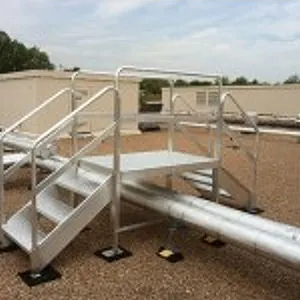
Piping, conduit, cable runs, ductwork, and other infrastructure can cross a normal walking path. A crossover stair provides a controlled route above the obstruction rather than encouraging employees to step over it.
That can be particularly useful in mechanical yards and industrial environments where routing everything underneath a walking surface simply is not practical.
REDD Team manufactures OSHA crossover stairs that can be adjusted for different heights and site configurations. Its modular access capabilities allow the crossing platform and stair arrangement to be designed around the obstacle rather than using the same dimensions for every application.
Why Do Walking Surfaces Matter Outdoors?
A power facility does not stop operating because it rained.
Exterior equipment access can be exposed to water, snow, ice, mud, or debris. That makes the walking surface an important part of the design rather than a cosmetic choice.
REDD Team offers slip-resistant, self-draining surfaces for its industrial access systems. Generator platforms can incorporate Grip Strut-style decking, which provides traction while allowing rainwater to pass through rather than remain across the platform. Less aggressive decking is also available when the application calls for it.
Self-draining construction has another practical benefit.
Leaves, rain, and small debris are less likely to remain trapped on a solid platform where they can create additional maintenance.
What OSHA Requirements Should Be Considered?
Industrial access has to account for more than getting the stair angle approximately right.
Under OSHA’s general-industry requirements, standard stairs must meet criteria covering tread and riser dimensions, width, landings, load capacity, and uniformity. For example, stairway platforms generally must be at least as wide as the stair and at least 30 inches deep in the direction of travel.
Elevated surfaces can also require guardrails and other fall-protection measures. OSHA generally specifies a top-edge height of 42 inches, plus or minus 3 inches, for guardrail systems, along with strength and intermediate-member requirements.
The exact requirements depend on the application.
That is why access equipment should be selected using the actual elevation, layout, intended use, and governing standards rather than assuming that any prefabricated staircase will work.
Why Is Aluminum Well Suited to Power Facilities?
Aluminum solves several practical problems at once.
It is corrosion resistant, lightweight, noncombustible, and strong enough for demanding structural applications. REDD Team notes that aluminum alloys can offer strength comparable to many structural steels at roughly one-third the weight.
Lower weight can simplify delivery and installation, especially on rooftops or around equipment where moving a large, welded steel assembly would be difficult.
There is also less upkeep.
Aluminum does not need paint simply to prevent rust, and it will not rot like wood. That makes it particularly useful for systems that may spend their entire service life outdoors next to generators or other utility equipment.
Can Access Systems Change When the Facility Changes?
They can when modular construction is used.
Power requirements rarely remain frozen for the lifetime of a building. A generator may be upgraded. Another unit may be added. Mechanical equipment can be relocated during an expansion.
REDD Team’s aluminum access systems can be configured and, in many cases, reconfigured around changing equipment needs. The company’s products arrive pre-engineered or prebuilt for relatively straightforward field installation, while custom solutions are available when stock dimensions will not solve the problem.
That can extend the useful life of the access equipment instead of requiring a completely new fabrication every time the facility changes.
Plan Access Around the Work That Needs to Be Done
The most effective access solutions for power generation facilities begin with the maintenance task itself. Determine which equipment employees must reach, how often they go there, what they carry, which obstructions are in the route, and how much working space is required once they arrive. From there, stairs, platforms, crossovers, and walkways can be configured into a practical access system.
REDD Team manufactures aluminum generator platforms, industrial stairs, walkways, crossover stairs, and custom access products in the United States. The company also provides engineering and design support for facilities with unusual elevations, equipment layouts, or access challenges.
For help developing an access system for a power generation facility, call REDD Team at (800) 648-3696 or request information online. A purpose-built route can make routine inspection and maintenance easier long after the installation crew has left.